
 Español
  English
  Italiano
  Català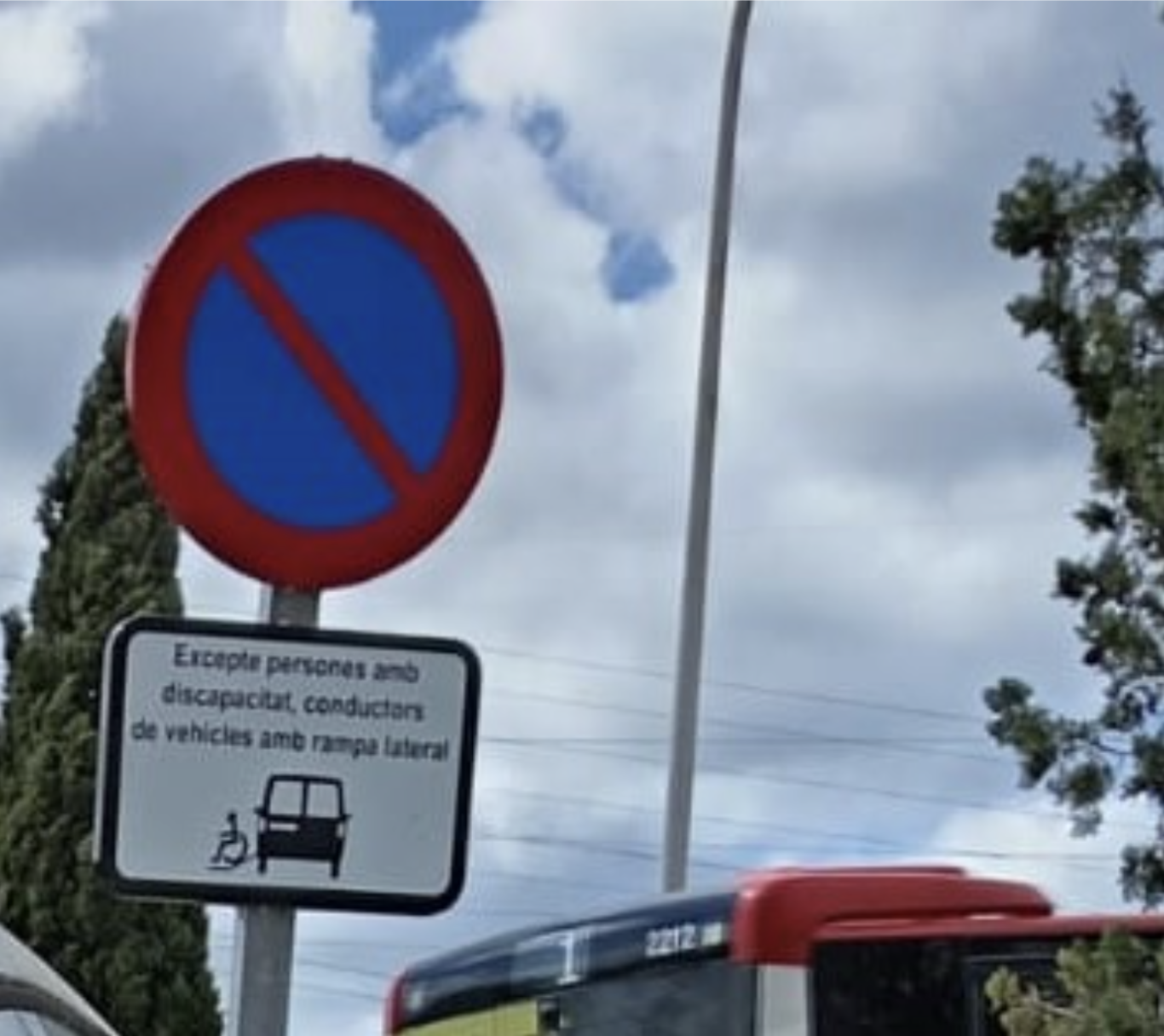
A few days ago, a person with a parking permit for people with reduced mobility (PRM) wrote to us recounting their experience. They parked in a reserved space within a hospital complex, duly marked as a PRM space, but upon leaving, found a ticket on their windshield. The confusion arose from the text on the sign, which read:
“Excepte persones amb discapacitat, conductors de vehicles amb rampa lateral.” (Except people with disabilities, drivers of vehicles with a side ramp.)
The citizen interpreted that the space was reserved for people with disabilities (like himself), and also for drivers of vehicles with a side ramp, but not exclusively for the latter.
📌 What interpretation is valid?
This type of wording creates confusion: the comma can imply that there are two beneficiary groups. However, the pictogram on the sign (which clearly shows a vehicle with a side ramp) provides additional information that qualifies the restriction.
At AsoPMR, we do not issue definitive legal assessments, but we do observe that, in this case, the sign as a whole (text + pictogram) can be interpreted as a restriction exclusively for vehicles with a side ramp. Even so, we recommend that the citizen submit an appeal to the City Council, explaining their case and attaching all documentation, as the wording is ambiguous and deserves review.
🔎 What can AsoPMR do?
- We offer advice for unclear ticketing cases.
- We collaborate with local entities to review and improve signage.
- We promote awareness campaigns on the correct use of PRM spaces.
🧭 And we add a necessary reflection:
Beyond the specific interpretation of a sign, one must ask whether it was really necessary to reserve that space exclusively for vehicles with a side ramp. Had a prior analysis been done on the actual demand? Were there enough generic PRM spaces in the area to cover the needs of the rest of the community?
Those who decide to install this type of signage should ask themselves these questions. Today, there are tools and technologies that allow for data-driven planning, accessibility mapping, and a more equitable and efficient distribution of urban space. At AsoPMR, we promote the use of these solutions to help administrations make informed decisions, based on criteria of inclusion, fairness, and efficiency.
This case reminds us of the urgent need to review and standardize PRM signage in our urban environments. Clear, accessible, and consistent signs not only prevent conflicts and unfair penalties but also reinforce respect for the rights of the PRM community and the proper management of public space.
At AsoPMR, we work with city councils and organizations to improve this reality.
Together, we promote clearer, fairer, and more inclusive mobility for all people.
You Move Us!