 Español
  English
  Italiano
  Català
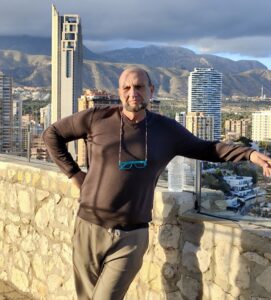
 Today we interview Carlos Viñals, a cheerful and lively person, who explains his vision of life, disability, and persistence. He describes himself as someone who doesn’t give up; fighting is not an option. In this conversation, he tells us about his way of understanding reduced mobility, the challenges he has faced and continues to face, and the importance of attitude in overcoming unexpected situations.
Tell us a bit about yourself: What’s your name, how old are you, and how would you like us to describe your situation as a person with reduced mobility?
My name is Carlos Viñals, I’m 68 years old. Following a severe fall, I broke two vertebrae, which had to be reconstructed with synthetic material, leaving my spinal cord compressed by 80%. This led to me being put on sick leave from work and transitioning to a permanent disability status with a 56% impairment rating. More than three years ago, I was diagnosed with rectal cancer, requiring many sessions of radiotherapy and chemotherapy. A year after my surgery, I had metastasis in my liver and part of it had to be removed. Currently, I am cured of both cancers, but the radio and chemo affected me and slightly worsened my mobility.
For those who don’t know you in person, what qualities do you think define you?
I am a very cheerful and optimistic person; this helped me a lot to overcome both the back accident and the two cancers. Due to my jovial nature, I always like to help others and encourage them when they have a problem or depression.
What do you think has inspired your spirit of overcoming throughout your life?
My optimism and perseverance. I never give up, no matter what it takes.
Is there any historical or fictional figure that inspires you?
Yes, there are some, but I highlight the late and much-loved Felix Rodriguez de la Fuente, and Commander Cousteau, for their dedication to the conservation of our planet and its fauna, and for the love of animals that both shared.
How has your perspective on limitations and possibilities evolved throughout your life?
Well. When I was younger, I had fewer limitations than now, but currently, I accept them because I’ve matured more.
Is there any event or encounter that made you “click” regarding your situation?
I don’t quite understand the question, but if it refers to this survey, I’m doing it to collaborate and help other people with disabilities face it with optimism.
How do you take care of yourself physically and mentally?
Mentally, well, and physically, I do what I can. Every day I walk about 4 or 5 kilometers.
And mentally, is there anything that helps you?
My wife and my optimistic nature, which prevents me from faltering.
What are the biggest challenges you’ve faced in your life and how have you overcome them?
That’s a difficult question. I’ve had many, but I prefer to save it for another occasion.
What message would you give to those who are going through difficult times and need to find motivation?
I would tell them that life passes very quickly and that you have to make the most of it. Complaining and letting depression take over doesn’t help at all, and besides, it’s time you lose in admiring life and enjoying it.
On the path to inclusion and accessibility, what are the major milestones that are still pending? Or what major headlines would you like to read in a newspaper about inclusion and accessibility?
I don’t know about the topic, as I’m still new to this field, but I think better government aid for our group would be appreciated. The headlines would be those referring to what was mentioned above.
Is there any cliché about disability that you think is very present in society?
I don’t know, but I observe that some people look at us like “strange creatures,” especially people who have to use a wheelchair.
What are your next personal goals?
For now, to move house and relocate to another community. As for my disability, to continue improving every day to be able to live as normal a life as possible, trying to reduce mobility problems as much as I can.
Is there any message you’d like to send to AsoPMR members or anything you’d like to add?
Encourage the entire group to move forward with our current and future demands.
How did you feel responding to this interview? Has it been a significant experience for you? Your testimony can encourage other members to share their story.
I felt good being able to share my experience to help other people overcome the fears or uncertainties that affect us due to our situation. If we unite, we will have more strength and, at the same time, we will feel accompanied. For me, answering this survey has given me satisfaction because another person can read my answers and they can serve to reflect on their mood and infect them with my enthusiasm for life. I also want to comment that the best companion we have is our willpower and desire to move forward with our disability. Let’s not betray ourselves by giving in to bad thoughts; let’s fight, because we can!