 Español
  English
  Italiano
  Català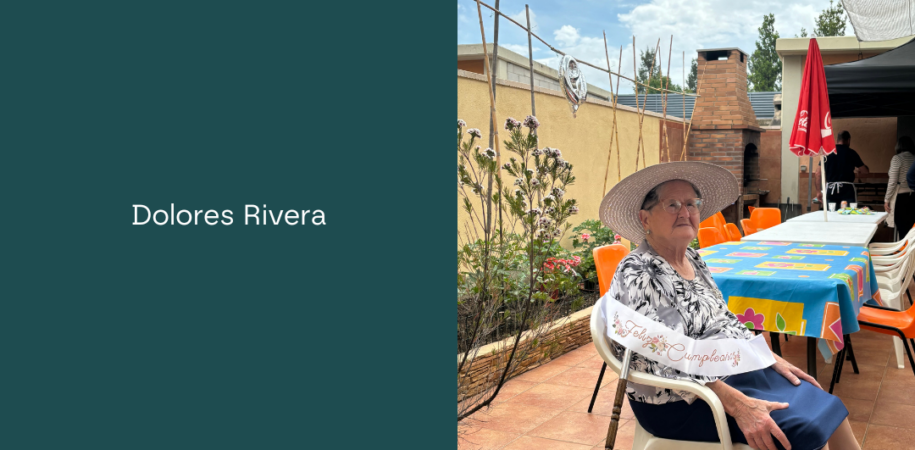
Today we share the story of Dolores Rivera. A 94-year-old woman, born in Palenciana in 1931.
Her experience with disability began in her 40s, when she suffered an unknown infection that left her legs paralyzed for a period of time, forcing her to spend months in the hospital. Today, Dolores is a woman who has learned to walk again and goes wherever she wants, always accompanied by her walker for support — without it, it would be impossible.
We invite you to read her story in her own words:
Tell us a bit about yourself: what is your name, how old are you, and how would you like us to describe your situation as a person with reduced mobility/disability?
My name is Dolores Rivera, I was born in 1931 and I am 94 years old. I am from Palenciana, Córdoba, but I have been living for more than 60 years in a small neighborhood in Tarragona, where I built my family with my husband and our four children.
My situation with disability has always been changing because when I was around 50 years old (I don’t remember exactly), I had an infection that left me paralyzed from hips to toes for three months. During that time, I was hospitalized, and over time I was able to recover. Little by little I started walking again, but I never fully regained full mobility again.
For those who don’t know you personally, what qualities do you think define you?
I am a very devoted person. It doesn’t cost me anything to do favors and “I don’t have anything that is only mine,” meaning that if I can give something I always do.
What do you think has inspired your spirit of perseverance throughout your life?
Leaning on God, whom I have believed in since I was little, and thinking about my family, who always give me reasons to keep moving forward no matter the situation.
How has your perspective on limitations and possibilities evolved throughout your life?
At 50, I thought I was going to die. I was paralyzed for a time, then I improved, but now I use a walker.
Is there any event or encounter that changed your perspective over time?
I have always thought that no matter how bad I might feel, there are always people who suffer more. Depending on the stage of my life, I have felt more or less motivated about my possibilities, especially during those months in the hospital when I felt like I was dying.
Fortunately, I have always been surrounded by my family and I have never lacked their support.
On the other hand, do you do anything that helps you physically or mentally?
Physically, I try to go out for a walk at least twice a day to exercise my legs, always with the help of my walker and stopping often to rest.
What have been the biggest challenges in your life and how have you overcome them?
One of the hardest things for me in recent years has been not being able to take care of my own home. I can’t clean properly, I can’t cook well, and I can’t go shopping without discomfort. Currently, I need someone to come and clean and to help me shower, because for years now I haven’t been able to do it by myself.
What message would you give to people who are going through difficult times and need motivation?
We cannot spend all our time thinking about the bad things. Sometimes things are simply the way they are, and all we can do is move forward, accepting that not everything in life is good, but we are surrounded by many things that are.
The phrase I always use to accept a situation is: “Let God’s will be done.” I cannot change things, only let them happen.
On the path toward inclusion and accessibility, what major milestones are still pending? Or what headline would you like to read in a newspaper about inclusion and accessibility?
More public spaces where people can spend time peacefully, well maintained, clean, and accessible.
As a headline:
“Loneliness and barriers in old age come to an end, older people reclaim public spaces.”
Is there any cliché about disability that you feel is very present in society?
Personally, before using my walker, I felt very embarrassed about it. I didn’t want to use it in public. Now I can’t be without it. I know other women in my neighborhood who feel the same way and prefer to walk with a cane instead of a walker out of embarrassment, but in the long run, the cane strains your shoulder and causes pain.
I would tell these people that once you accept your situation, your limitations and your abilities, you stop feeling ashamed of support devices like a walker or anything else.
What are your next personal goals?
I have already done what I had to do. Now my wish is for my family to be healthy and have prosperity.
Is there any message you would like to send to the members of AsoPMR or anything you would like to add?
Don’t let shame or fear paralyze you. Seek support in whatever helps you: family, faith, people you meet in associations, etc.
How did you feel answering this interview? Has it been meaningful for you? Your testimony may encourage other members to share their stories.
Wonderful. Being able to share my experiences with AsoPMR whenever I can means reviewing some of the most significant moments of my life.