 Español
  English
  Italiano
  Català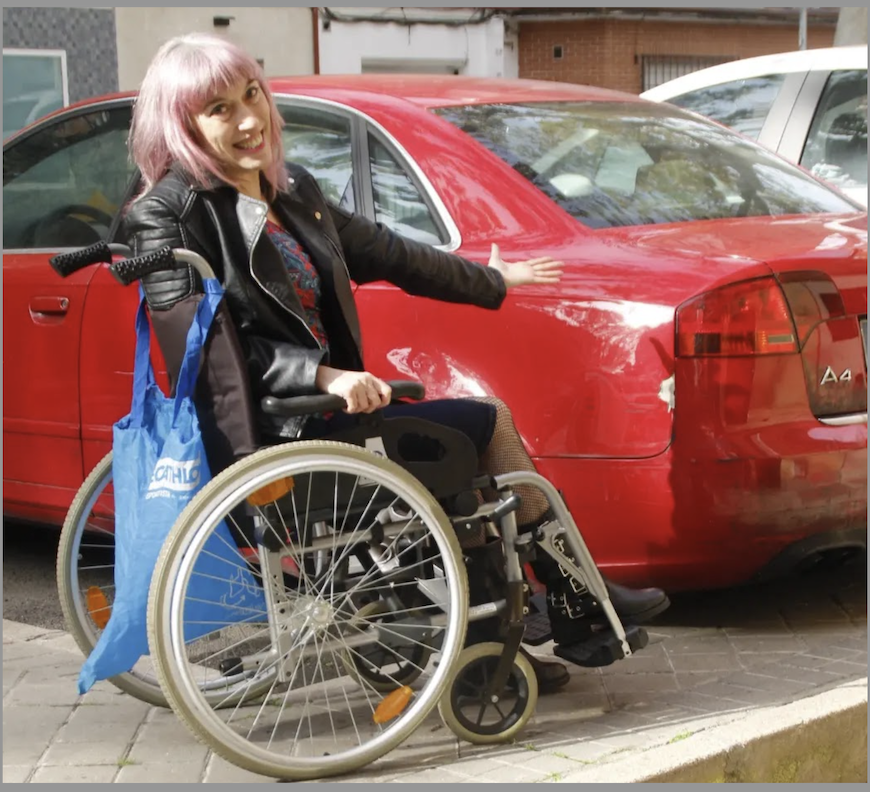
Tell us a bit about yourself: what’s your name, how old are you, and how would you like us to describe your situation as a person with reduced mobility?
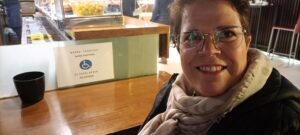
My name is Cristina. I am 51 years old.
It’s July. After thirteen days in the hospital, I stopped walking for a few months, with tension and discomfort in my body every time I move it and with very little energy in general. With no one in the square in front, I sunbathe with my dark glasses and my wheelchair.
I’m back at my parents’ house, away from my home, dependent on them to shower, prepare food, reach objects, move around, lie down. Thanks to their invaluable help, I haven’t needed a nursing home or to stay in the hospital for care. But for them, this situation also comes at a price: they can’t go on leisure trips or have much of a social life. The three of us are stuck in a peripheral neighborhood of the big city, semi-empty due to the temporary exodus of a well-deserved vacation.
For those who don’t know you in person. What qualities do you think define you?
I’ve always been like the Phoenix, rising from the ashes. With more or less effort, I get up, learn, walk, fall again, and with each fall, I add another lesson. This experience of temporary disability has reminded me that I am like that, that I have that strength.
What do you think has inspired your spirit of overcoming throughout your life?
Being able to see all the attractive, rich, and joyful aspects of life has kept me going, even in times when I didn’t know where to turn.
Is there any historical or fictional figure that inspires you?
I’m inspired by classic American film comedies, where they can explain dark aspects with vitality and humor, without sugarcoating, but rather by shifting the vision of reality. I’m also inspired by the dancers of great Broadway musicals and Burlesque artists, brave and empowered, like Gypsy Rose Lee.
How has your perspective on limitations and possibilities evolved throughout your life?
I used to live with the limiting belief of what we can and cannot do, of the lack of possibilities, of “don’t even try, what’s the point….” and little by little, after “missed trains,” you realize that many things can be tried, that failure is blessed because it makes us learn. And there are many ways to do things. Metaphorically speaking, when you’ve missed a train, you can take a bicycle; you might not get as far and you might get tired, but you enjoy the journey calmly, with stops chosen by you; you are the owner of your own path, because you are the one pedaling.
Is there any event or encounter that made you “click” regarding your situation?
A past work experience I had in Ireland made me “click.” I was an assistant to a girl who was born with spina bifida: I helped her get up in the mornings, with her hygiene, breakfast, drove her van to work. In her work environment, I collaborated with her administrative tasks… The relationship I had with her taught me a lot about people in situations of dependency, their lack of privacy, their energy to keep going, the necessary sense of humor…
And, as life would have it, when I found myself in a similar situation, those months I lived with her served as a learning experience. I remembered her a lot.
How do you take care of yourself physically and mentally?
In my most dependent phase, I felt the body I had, with the capacity for movement that was available at that moment, and I acted from there. I didn’t want to go further, no pun intended. With social relationships, the same thing happened; being much more limited, the ones that arose were valued with gratitude. And it could be the people who spontaneously spoke with me in the square.
And mentally, is there anything that helps you?
Reading helps a lot, it makes you move from your chair, experience stimulating situations from your bed. It allows you to live the lives of others and not your own, so you forget your worries.
Also, something close to meditation, looking, feeling what is around you, breathing it, without overthinking your own issues.
What message would you give to those who are going through difficult times and need to find motivation?
My message is that patience is a difficult but surprising vital attitude. If you manage to minimize anxiety, understand yourself in your low moments, look inwards without rushing… a day comes when motivation appears without you realizing it, like an inspiration.
On the path to inclusion and accessibility, what are the major milestones that are still pending? Or what major headlines would you like to read in a newspaper about inclusion and accessibility?
One that comes to mind is adapted homes. The construction of accessible homes that allow the dependent individual to live as autonomously as possible.
Headline: The government approves the budget for the construction of accessible housing.
Is there any cliché about disability that you think is very present in society?
Infantilizing people with some type of disability. As if they were beings from another world, naive and fragile. With astonishment if they experience fleeting emotions like frustration or anger, common in the average individual and necessary at specific moments to keep going.
What are your next personal goals?
They are all physical: to be able to dance again, practically at the level I was before. To do a small mountain route without fear of tripping. To run minimally, at least to catch the bus that’s about to leave….
Is there any message you’d like to send to AsoPMR members or anything you’d like to add?
Association in this case (and many others) is essential. Neither the administration nor the citizens will sufficiently look out for this group if we do not demand it. I believe that making ourselves visible and dignified contributes a lot to society.
Therefore, AsoPMR and similar organizations are essential for the support and companionship of many people. I thank and congratulate you.
How did you feel responding to this interview? Has it been a significant experience for you? Your testimony can encourage other members to share their story.
Answering this interview has been a gift. The questions lead to very constructive self-reflection; it is also a tool to value oneself and understand the strength and intelligence that emerges in difficult moments.